Souls & Estates is a strategy game about a Russian noble house from 1670 to 1861. You set what each serf village owes, lay out the land, marry off your children and climb the Table of Ranks. It is free in the browser and on Windows on itch.io, in English and Russian.
On 10 November we took it to a game developers’ meetup and let people play. Nobody had trouble with the idea. Everybody had trouble with the screen.
What we heard
- Too much text. Every page was a wall of words, and you had to read it before you could click anything.
- Russian words in the English game. Chetverts, sazhens, vedros, obrok, barshchina. They are right for the period and mean nothing to an English speaker.
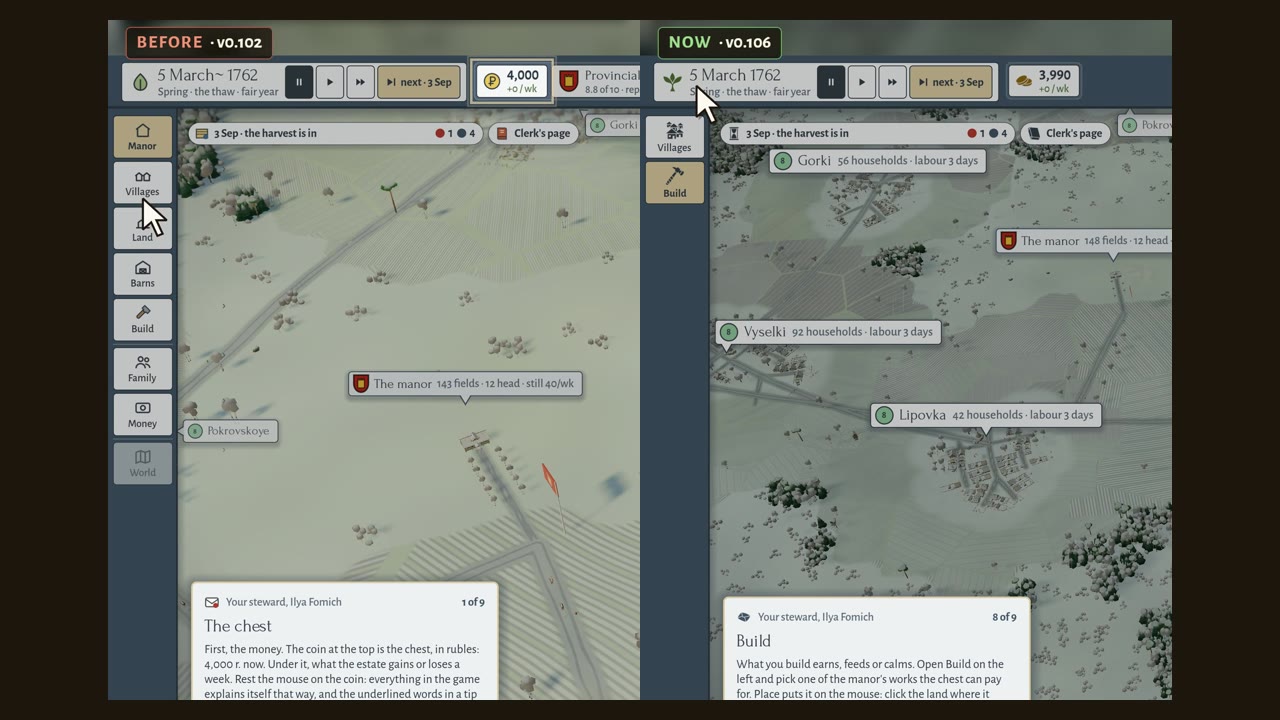
- Everything at once. The guided start opened on step 1 of 9 with all eight tabs, the whole top bar and a page of numbers already on screen.
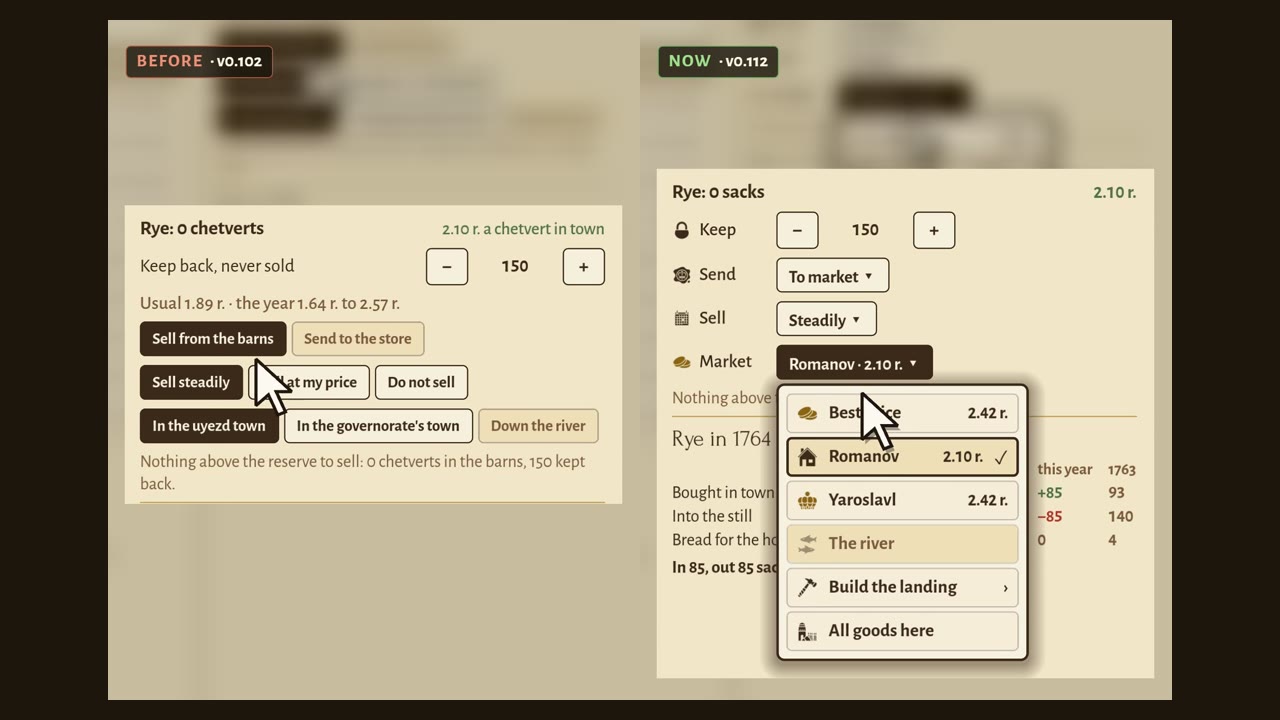
- Menus that unfold inside the page. A button with choices under it opened a list in the middle of the page and pushed everything else down. The idea that replaced it came from the meetup too: a small pop-out next to the button.
None of it was news to anyone except us. We had stopped seeing it because we knew what every word meant.
Plain words (version 0.104)
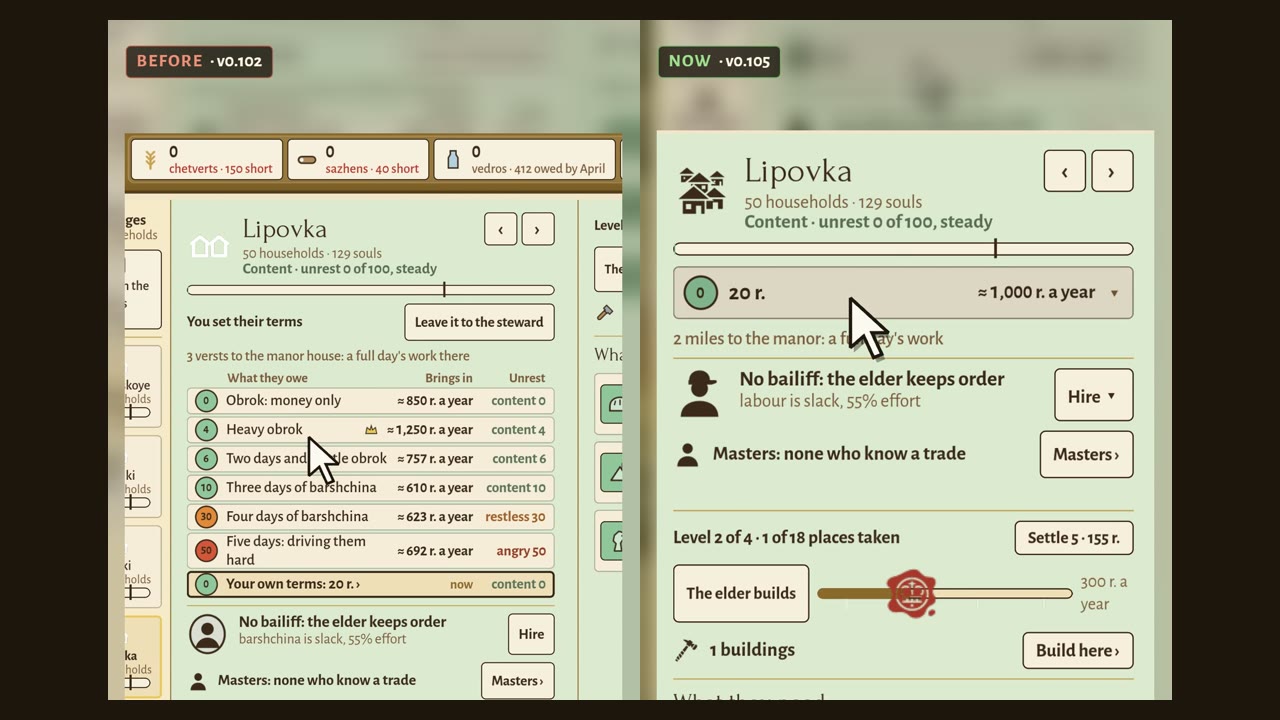
The English text no longer holds transliterated Russian. Obrok is rent. Barshchina is labour. A chetvert of grain is a sack, a vedro is a bucket, a sazhen of firewood is a cord, a verst is a mile and a desyatina is an acre, with the numbers converted on the screen. A uyezd is a district and a governorate is a province. We kept the words English already has: Tsar, boyar, Cossack, ruble, kopeck, samovar, kvass, serf and souls.
A rule like that rots unless something checks it, so the game’s own tests now fail if an old word creeps back into the English text. The Russian edition keeps its own words, of course.
Icons and pop-outs (0.103 to 0.107)
Version 0.103 brought a new icon set: 150 bold one-colour silhouettes from game-icons.net, which are free to use with credit, and 19 we drew ourselves, among them one family of busts for the people. We picked solid shapes on purpose, because thin line icons turn to dust at 14 pixels.
Version 0.105 put the pop-out everywhere: a button that hides choices opens a small menu next to it, and a click anywhere else closes it. A village’s terms used to be a table of six rows on its page. Now they are one row with the current choice, and the six options open on a click. Version 0.107 did the same to every tall section of the office: notes, orchards, hay, waters, lawsuits.
The barns went furthest. Selling rye used to take three rows of buttons. Since 0.112 it is four short rows, Keep, Send, Sell and Market, each with one sign and one word, and the markets with their prices open in a pop-out. That one came three days after the meetup, when we saw that the first pop-outs still left too many words on the page.
A tutorial that starts with nothing (0.106)
The guided game now opens on the land alone, with your steward. The office arrives a piece at a time, when the steward gets to it: the Villages tab, the chest, the clock, the letters, the Build book, the Manor. The rest of the pages open through the first year, one at a time, and the steward tells you when a new one is there. You can open it at once or later.
Two more things from that week
- Frame rate. The game had no frame limit. On a laptop with a 240 Hz screen it asked for 240 frames a second and kept the graphics card working flat out, even when paused. Version 0.108 added a Frame rate setting (60 by default, 15 while the game sits behind another window) and a Detail setting. On our test laptop, Light takes the graphics card’s work per frame from 12.8 to 6.6 milliseconds.
- Fields. Peasants farmed in narrow strips, and in our game every strip looked the same, like striped wallpaper. Version 0.113 gave each strip its own shade and a few other crops here and there, and the harvest now comes in strip by strip and leaves stooks on the stubble.
Where it is now
Version 0.114 is on itch.io, in the browser and as a Windows download. Short films about these changes, before and after, are in our Souls & Estates playlist under the name “What changed”.
There are still more words than we want, and some pages still need two columns. If a screen makes you stop and read when you only wanted to click, tell us which one: contact@goldenharbourgames.com or the comments on the itch page.